The Word Local: What a Food Label Leaves Unsaid
Learn what a local food label can—and cannot—tell you, with clear questions for checking distance, production, season, and who benefits from the sale.
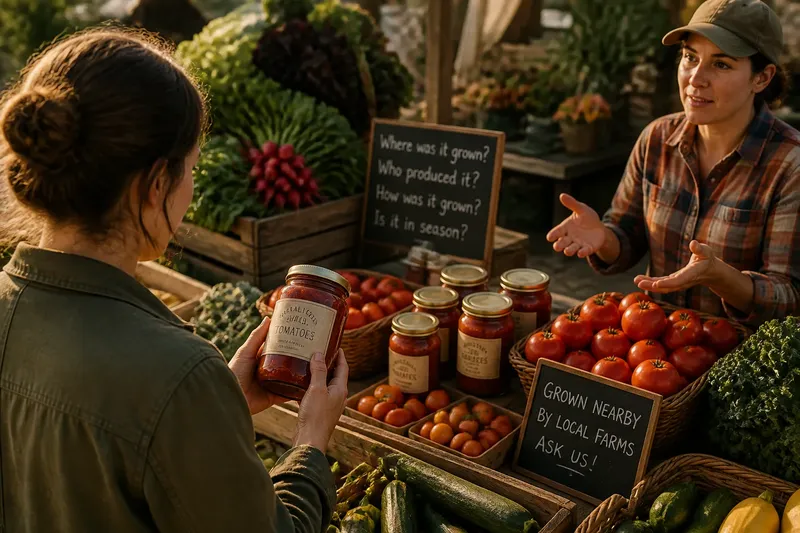
What does “local” actually tell you about the food in your basket? Usually, it identifies a connection to a nearby place, but the label alone may not say how near, how the food was produced, when it was grown, or who receives the income. Reading a local food label well means treating the word as a starting point and asking what kind of connection matters for this purchase.
Read local as a place claim, not a complete description
A jar marked local could refer to where its main ingredient was grown, where it was processed, or where the business is based. Those are different claims. A nearby bakery might make bread with flour from far away; a local farm might sell produce through a distributor that packs it elsewhere. The word on the front may not clarify which link it describes.
Look for a farm name, town, county, region, or other place printed on the package or price card. Then check what that location refers to. If the label says “made locally,” it may describe processing rather than the origin of every ingredient. If it names a farm, ask whether that farm grew the food or sourced it from other producers.
Local also has no single distance boundary that applies to every retailer and community. A store may define it by a stated radius, a regional boundary, or a list of approved suppliers. If no definition appears, ask the seller what the term means there instead of assuming that another shop uses the same standard.
Choose the question that fits your situation
If you want food grown near home, what should you check?
Ask where the ingredient was grown, rather than where it was packed or sold. A farm address or a clear growing region is more useful than a general “local” badge when proximity is your main concern.
If you care how it was produced, what should you ask?
Ask about the specific practice you care about, such as pest management, soil care, animal feed, or greenhouse production. “Local” does not describe those methods, so look for a separate production claim or a direct explanation from the grower or retailer.
If you want to know who benefits, what should you ask?
Ask who grew or made the food and how it reaches the seller. A named producer and a clear account of the supply relationship can help you understand who is involved, though the word local alone does not reveal payment terms or working conditions.
If you are comparing local and imported options, what should you compare?
Compare the details relevant to your choice: origin, production information, season, and the available supply route. A local product is not automatically better on every measure, and a product from farther away is not automatically a poor choice.
Separate distance from production method and season
Place, method, and timing answer different questions. A nearby crop can be grown outdoors or under cover; a nearby food can be produced using practices that differ from your preferences. Likewise, a local item may be available outside its usual outdoor season because it was stored, grown in a protected setting, or processed. The label “local” does not tell you which explanation applies.
If season matters to you, ask whether the food was grown outdoors nearby and whether it is currently being harvested. A seller may know whether produce is fresh from a farm, drawn from storage, or grown under cover. These details are more informative than guessing from the word on a sign.
If a production claim matters, seek the exact wording and ask what it covers. “Local” is not a substitute for a specific claim about organic practices, animal care, or handling. When a label refers to a regulated certification or a particular growing method, the product label, producer, or relevant local rules are the right places to clarify what it means.
Use a short set of questions at the store
- Where was the main ingredient grown or raised? Ask for a farm, town, or region, not only a packing location.
- What does this seller mean by local? Check whether the store has a boundary or supplier policy.
- Who produced the food? Find out whether the named business grew it, made it, or resold it.
- What production details matter to me? Ask about the practice that affects your choice instead of expecting local to answer it.
- Is it in its local harvest season? Ask whether it is freshly harvested, stored, or produced under cover.
- What part of the product is local? For prepared foods, distinguish local processing from local ingredients.
You do not need an answer to every question for every purchase. Start with the one that would change your decision. If origin is the priority, ask where the ingredient grew. If a particular farming practice matters, ask about that practice. A concise, relevant question is often easier for a seller to answer than a broad request to explain the whole supply chain.
Decide what to do when the answer is incomplete
Sometimes the seller knows the producer but not the details of a growing method. Sometimes a package names a region without identifying a farm. Treat an incomplete answer as a limit on what the label tells you, not as evidence for or against the food. You can decide whether the information you do have is enough for this purchase.
Imagine you are choosing between two jars of tomato sauce. One says “local” but gives no ingredient origins; the other names a nearby producer and identifies its tomatoes as locally grown. If knowing where the tomatoes came from is your priority, the second label offers a clearer basis for that choice. It still does not tell you every production detail, so ask about those separately if they matter to you.
If a retailer cannot answer, check the package, producer’s website, or a farm’s own listing when available. For loose food at a market, ask the vendor whether they grew it or bought it from another supplier. If the origin remains unclear, you can choose based on the information available or select a product with a more specific claim.
Keep the label useful without asking it to say everything
Local can be a helpful clue: it may point toward a nearby producer or a regional supply relationship. But it is not a full account of distance, growing conditions, season, or the people involved. That distinction matters because each shopper may be looking for something different.
For a local food label, begin with the question most connected to your priorities, then look for a concrete answer: a named place, a named producer, a described practice, or a clear account of what “local” means at that shop. The most useful label is not necessarily the one with the warmest wording; it is the one that helps you make the choice you intended.